Bot and AI crawler protection for websites and apps
Centinel verifies search and AI crawlers and detects scrapers that run real browsers behind residential proxies. Your access policy then blocks the scrapers and allows the crawlers you trust.
Centinel detected 8 of 8 automation tools in our September 2026 benchmark. The best of six other vendors detected 5. See the benchmark
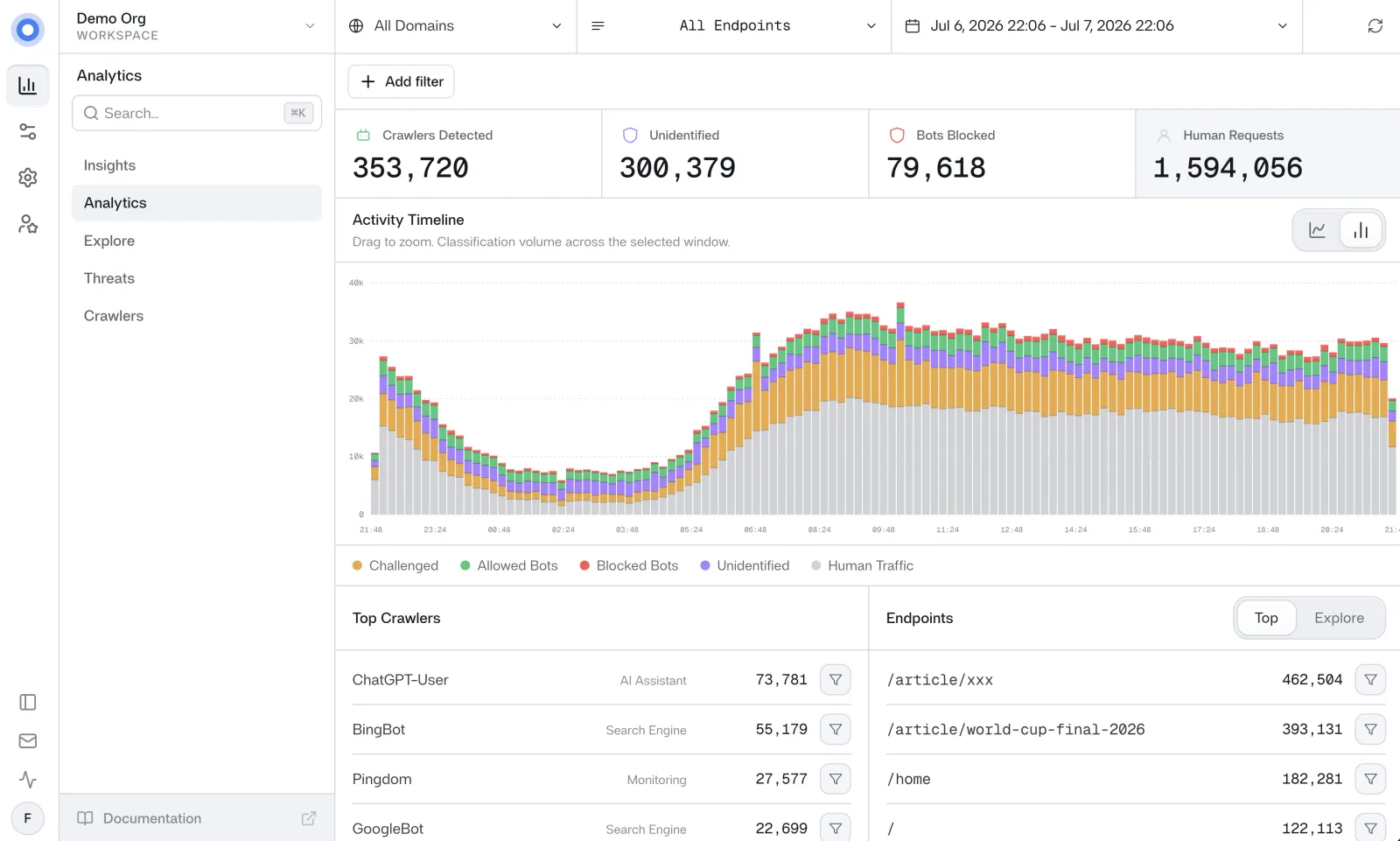
Featured by news outlets and industry bodies










Where automated traffic costs you
Bots copy content, take over accounts and call APIs directly. Each attack needs different evidence and a different response.
All use casesScraping and AI crawlers
Scrapers and AI crawlers copy your prices, product catalogue, and articles page by page, often through a real browser on residential IP addresses. Competitors undercut you with your own prices, and AI services answer with your content without sending the reader to your site.
Account takeover
Credential-stuffing bots try leaked username and password pairs against your login form at machine speed, often from a new IP address on each attempt. Every match is a working account the attacker drains, resells, or uses for the next fraud.
API abuse
Bots call your API directly, so none of the checks that run in the browser apply. They pull data in bulk, test stolen credentials, or book stock faster than a person can. Each call can look like a request from your own app, and you pay for the server load and any paid service behind it.
Bot protection by industry
All industriesTell real visitors from scrapers that look like them
A scraper can run a real browser and look like an ordinary visitor. Centinel evaluates the request, the browser and the connection together, and does not decide from one signal.
- Declared crawlers
- Verify known identities and set policy per crawler.On a typical news site, 84% of requests claiming to be GPTBot were fake, and 14% of those claiming to be Googlebot. Read the reportLook up GPTBot, ClaudeBot, PerplexityBot, Googlebot, Bingbot, or any crawler in the bot directory and the AI crawler list.
- Basic scripted clients
- Identify scripts and HTTP libraries that do not behave like a browser.
- Browser automation tools
- Detect spoofed browsers and commercial scraping APIs.
It runs in the stack you already have
Your edge asks Centinel to check the request before serving the page. Keep your existing CDN, reverse proxy, or application in place.
Incoming traffic
- Real visitors
- Declared crawlers
- Scripted clients
- Spoofed and headless automation
- Browser-like scraping
Your edge
CDN, reverse proxy or application
- Cloudflare
- CloudFront
- Akamai
- Fastly
Centinel detection engine
Checks request and session signals against your policy.
- Allow
- Challenge
- Block
Your site
- Content pages
- Login
- Checkout
- APIs
Security and privacy, documented
Our information security management system is certified to ISO/IEC 27001. A SOC 2 Type 1 programme is in progress.
Trust CenterSecurity and data protection ISO/IEC 27001
 GDPR
GDPR SOC 2 programme
See which scraping tools get through
We run real scraping tools against your site, review the results by hand, and email you the report.
Common questions
What site owners ask before deployment.
How is this different from our CDN or WAF?
Your CDN and WAF stay in place. Centinel adds crawler verification and browser-side evidence for automation that looks like ordinary visitor traffic. Check what your current setup already detects on the routes that matter. Then test whether Centinel's evidence changes a decision on the traffic your setup misses.
What did the September 2026 benchmark test?
We ran eight scraping and browser-automation tools against seven products: Centinel, Akamai, Cloudflare, DataDome, Fastly, HUMAN Security and Kasada. The tools were Browser-use, Firecrawl, Browserbase, kernel.sh, Playwright Stealth, Camoufox, Zyte and Ulixee Hero. We recorded whether each product detected each tool. The results are our observations from the configurations we tested. Plans and settings differ, so test your own routes and traffic before you choose.
Why does Centinel check the browser?
Headers can be copied, so they do not show whether a person or a script sent the request. Where the integration supports browser collection, Centinel adds runtime and session evidence from the browser. Judge that evidence against the workflow it protects and your access policy.
Will visitors see a CAPTCHA?
Centinel's browser checks run automatically. The response a visitor receives depends on the integration and your policy. During your evaluation, test challenge behaviour, accessibility and session continuity.
Can we allow trusted crawlers while blocking scrapers?
Yes. Centinel separates declared and verified crawlers from spoofed or hidden automation, so your team can apply a different access policy to each traffic class.